
Last Updated: November 12, 2026
Quick Summary
Custom-ordered furniture fits your space better because it is built to your exact dimensions, materials and finish after you order, solving fit and storage problems that fixed factory sizes cannot. It suits awkward spaces and long-term homes, but costs more, takes weeks rather than days, and is hard to return once production starts.
- Measure wall length, depth and height clearance three times for every wall the piece will touch.
- Check doorway widths, stairwell turns and lift dimensions before ordering so the piece can reach the room.
- Get a written specification with exact finished dimensions, finish codes and lead time before paying a deposit.
- Custom lead time typically runs from several weeks to a few months depending on materials and build complexity.
- Skip custom if you rent short-term, need the piece within days, or simply haven't measured yet.
Table of Contents
- Why Custom-Ordered Furniture Solves Problems Ready-Made Pieces Can't
- Custom-Made Furniture vs Ready-Made Furniture: What Actually Differs
- A Perfect Fit for Room Dimensions and Awkward Spaces
- Bespoke Furniture for Small Spaces and Custom Storage
- Choosing Materials, Fabrics and Finishes That Suit Your Home
- How to Order Custom Furniture Without Getting It Wrong
- Custom Furniture Lead Time and What Drives the Cost
- When Custom Furniture Is Not Worth It
- Frequently Asked Questions
Why Custom-Ordered Furniture Solves Problems Ready-Made Pieces Can't
Most furniture disappoints for one boring reason: it was designed for an average room that doesn't exist. The benefits of custom ordered home furniture start with that gap. A standard sofa is built to a fixed depth, a fixed height, a fixed fabric list. Your living room has a radiator, a low window and a door that swings the wrong way.
This guide covers what custom-ordered furniture actually changes, where it costs more than it's worth, and how to order it without regrets. We'll show you the measuring steps, the materials trade-offs and the questions to ask before you commit.
Here's the tension most guides skip: custom furniture isn't automatically better. It's better when the problem is fit, storage or longevity. It's a waste of money when the problem is simply that you haven't measured properly yet.
Custom-Made Furniture vs Ready-Made Furniture: What Actually Differs
Custom-made furniture is built to your dimensions, materials and finish after you order. Ready-made furniture is built to a factory standard and sold from stock.
That single difference drives everything else. Made-to-order pieces take longer and cost more, but they solve fit problems that mass-produced furniture cannot. Ready-made pieces are cheaper and immediate, and for a spare bedroom or a rental, that's often the smarter call.
| Factor | Custom-Made | Ready-Made |
|---|---|---|
| Dimensions | Built to your measurements | Fixed standard sizes |
| Lead time | Weeks, not days | Immediate or next delivery |
| Cost | Higher, driven by spec | Lower, fixed price |
| Best for | Awkward spaces, long-term homes | Temporary setups, tight budgets |
| Returns | Limited once production starts | Standard returns apply |
One honest limitation: custom orders are harder to return. Once a piece is cut to your dimensions, it isn't resellable stock. That risk is real, and it's why the measuring and briefing steps below matter more than the design inspiration.
A Perfect Fit for Room Dimensions and Awkward Spaces
A perfect fit comes from measuring the room properly, not from guessing. If you want to explore outdoor furniture options where standard sizing and awkward spaces also matter, the same measuring rules apply. Take three measurements for every wall the piece will touch: length, depth and height clearance.
Then measure the route in. Doorways, stairwells, lift dimensions and corridor turns decide whether a piece can physically reach the room. A common mistake is ordering a table that fits the dining room but not the hallway.
Measuring a Room Before You Order
Work through this checklist before you contact any maker:
- Measure wall length at floor level and at skirting height
- Note radiator positions, pipework and socket heights
- Measure every doorway width and height on the delivery route
- Check stairwell turns and lift internal dimensions
- Record window sill heights and how far windows open
- Mark where doors swing and how much clearance they need
- Photograph the space in daylight and again in the evening
Those evening photos matter. Colour and finish can read differently under warm artificial light than under a north-facing window.
Bespoke Furniture for Small Spaces and Custom Storage
Bespoke furniture for small spaces earns its keep by using the volume you already have.
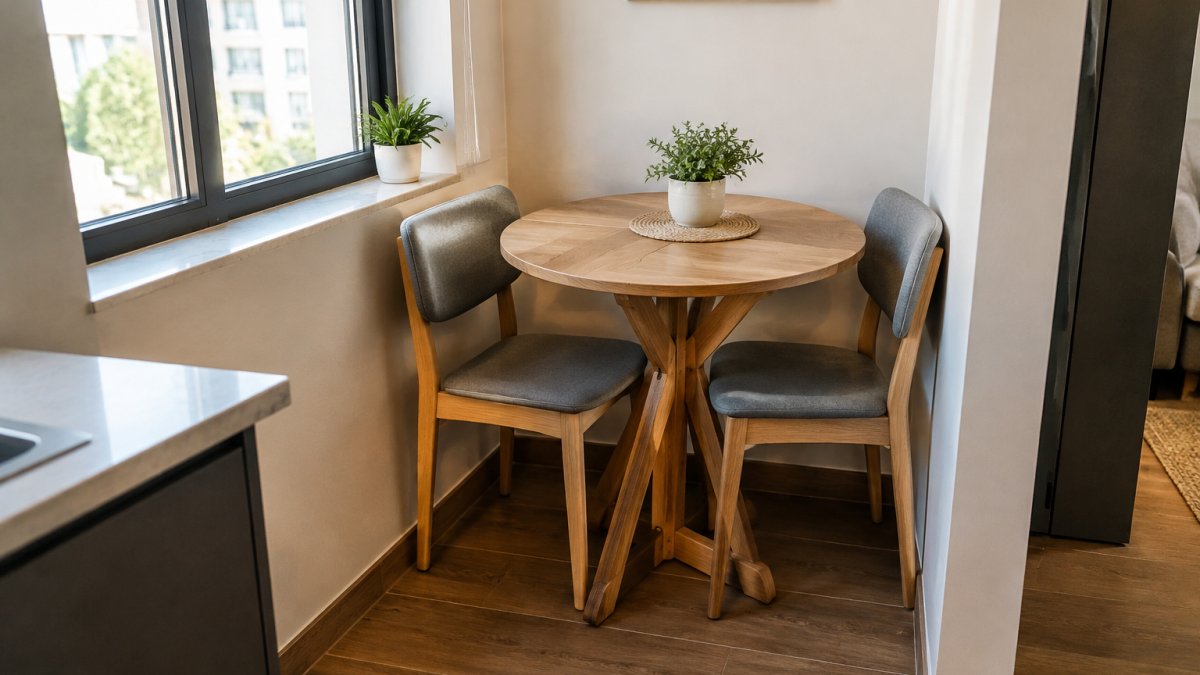
If you're weighing options, our ready-made tables collection shows how far standard sizing can stretch before you need something built. The Round Folding Table BT28 at €32 is a compact option for small spaces.
Custom storage is where the maths usually works. Floor-to-ceiling shelving in an alcove adds usable volume that no freestanding unit matches. Just be realistic about the trade-off: built-in storage is difficult to move, so it suits owners more than renters.
Choosing Materials, Fabrics and Finishes That Suit Your Home
Material choice decides how a piece ages, not just how it looks on day one. Wood type, upholstery and finish each carry different wear patterns, cleaning needs and repair options.
For upholstery, think about who uses the room.
Our dining chairs are available in several fabrics and finishes. The Tufted Faux Linen Dining Chair F-312 at €88 and the Tufted PU Leather Dining Chair F-316 at €76 sit at similar prices with very different care routines.
Watch out: fabric swatches viewed on a phone screen are unreliable. Ask to see the actual material under both daylight and a warm bulb before you approve a custom finish.
How to Order Custom Furniture Without Getting It Wrong
Ordering custom furniture works best as a written brief and a staged process, not a single conversation. Orders can go wrong when measurements are taken by the wrong person, a finish is approved from a screen, a deposit is paid before the specification is written down, or a delivery route is never checked. A staged process helps close those gaps before money changes hands.
The Ordering Process, Stage by Stage
1. Consultation and brief. Start with a written brief: the room, the problem the piece solves, your dimensions, your material preferences and your budget ceiling.
2. Measurement. Decide early who is responsible for the final measurements. On a fully custom build, the maker usually confirms dimensions before cutting, but you should still supply your own wall, doorway and route measurements as a cross-check.
3. Design approval and specification. Before any deposit, ask for a written specification: exact finished dimensions including overhang and trim, material and finish codes, hardware, and the confirmed lead time in weeks.
4. Deposit and fabrication. A deposit commits the maker to cutting material, and once a piece is cut to your dimensions it is not resellable stock.
5. Delivery and installation. Confirm the delivery route before fabrication starts: doorway widths and heights, stairwell turns, lift internal dimensions and corridor clearance.
What to Ask Before You Commit
Ask these questions before paying a deposit:
- What is the exact finished dimension, including any overhang or trim?
- Which specific material and finish code are you using?
- What is the confirmed lead time in weeks, and what could delay it?
- Who is responsible for the final measurements, you or me?
- What happens if the piece arrives damaged or the wrong size?
- Is there a written record of the specification I can check before fabrication starts?
If a maker can't answer all six clearly, that's your answer. For more guidance before you start, our blog articles on ordering cover the practical side of the process.
Custom Furniture Lead Time and What Drives the Cost
Custom furniture lead time typically runs from several weeks to a few months, depending on material availability and how complex the build is. A straightforward table in a stock finish moves faster than an upholstered piece in a specified fabric, and a built-in unit that needs site installation adds a further stage at the end. Most practitioners find that the quoted lead time is realistic for fabrication but optimistic for delivery, so add a buffer before you plan around a date.
What Drives the Price
Cost comes down to five drivers, and understanding them lets you prioritise spending rather than cutting blindly:
- Dimensions and volume. A larger piece uses more material and more labour hours. Going from a two-seat to a three-seat configuration is rarely a linear price increase because the frame and setup cost are shared.
- Material grade. Solid wood, veneered board and upholstered frames carry very different material costs and different labour times. A stock finish is cheaper than a specified one because the maker does not carry a one-off setup.
- Complexity of shape. Curves, angles, non-standard corners and integrated storage all add fabrication time. A rectangular table is the cheapest shape to build; an angled corner unit is among the most expensive.
- Finish work. Hand-finishing, matching an existing piece and multi-stage lacquers add labour. A single-colour stock finish is the lowest-cost option.
- Quantity and setup. A single bespoke piece carries the full setup cost of the build. Two matching pieces spread that setup across more furniture, which is why pairs and sets often price better per unit than a one-off.
Budgeting and Prioritising
Ask for the price broken into materials, labour and delivery. A maker who can itemise is usually a maker who has done this before, and an itemised quote lets you see where to trade off. If the quote is over budget, the usual order of sacrifice is: simplify the shape first, move to a stock finish second, and reduce size last, size is usually the reason you went custom in the first place.
For comparison, our Electric Adjustable Table RL001 is priced at €220.
Watch out: a quote that is dramatically cheaper than the others usually means a thinner material, a stock finish substituted for the specified one, or a lead time that will slip, ask which of the five drivers was reduced.
When Custom Furniture Is Not Worth It
Custom furniture is not worth it when a standard piece already fits. If your room is rectangular, your doorway is wide and your taste matches a catalogue, you're paying a premium for nothing.
Skip custom if any of these apply:
- You're renting short-term and may move within a year
- Your budget is tight and the space isn't genuinely awkward
- You haven't measured yet and are guessing at dimensions
- You need the piece within days, not weeks
- The problem is colour matching, which a stock piece in the right finish solves
The honest version: most people who think they need bespoke furniture need better measurements and a wider search of ready-made options first. Custom is the answer to a specific problem, not a general upgrade.
The real challenge isn't choosing a style, it's getting the fit right the first time. LivinMax helps by letting you see, touch and feel pieces in our showroom before deciding, with custom order options handled directly over WhatsApp for specific needs and budgets. Browse our chairs, tables and stools, or send us your measurements and we'll talk through what actually works in your space. Get started with LivinMax and furnish a room that fits properly.
Frequently Asked Questions
What are the main benefits of custom-ordered furniture?
The biggest gains are fit, choice and lifespan. A custom piece is built to your room dimensions, so awkward corners and narrow walkways stop being a problem. You pick the materials, upholstery and finish rather than accepting whatever a mass-produced range offers. The trade-off is a longer wait and a higher upfront price than an off-the-shelf item.
Is custom-made furniture more durable than mass-produced furniture?
It can be, but only if the maker is transparent about construction. Ask what the frame is made from, how joints are fixed and whether covers or components can be replaced later. A well-built custom piece is designed to be repaired, which extends its working life well beyond a flat-pack equivalent. Durability comes from the specification you agree, not from the word custom on its own.
How long does custom furniture take to make?
Ask for the lead time before you order, since it depends on the piece and the materials. Always ask for the lead time in writing before paying a deposit, and confirm whether it counts from order date or from material arrival. Build a buffer if you are furnishing before a move-in date.
Can I see and test custom furniture before ordering?
You should. Sitting on a chair and running a hand over a tabletop tells you more about comfort and finish than any photo. A showroom visit lets you check seat height, upholstery texture and how a finish looks under real light, which matters because screen colours mislead. Take your room measurements and a photo of the space with you so the conversation starts from what will actually fit.
